Showing posts with label Grade 7th/8th. Show all posts

Friday, July 31, 2009

Painting of Joseph and His Brothers

"Joseph Reveals His Identity" by Peter von Cornelius, German, 1783-1867
This picture is used in the 7th-8th grade English assignments for the second week of homework.
  1. Where is Joseph in this picture?
  2. Describe at least three people in this picture. Include their posture, expressions, and what they might be thinking.
  3. What is in the background of the picture?

Tuesday, March 31, 2009

Easter Week Classwork for Monday

Easter Week: Classwork for Monday, April 6

Our classwork for April 6 consists of reading some of the students' essays on The Great Commission & The Great Commandment, watching part of a video about Jesus, discussing a chapter from from the book Rainbow Garden by Patricia St. John, and listening to a Welsh hymn.

The following questions and activities related to Rainbow Garden are for class discussion:


  1. Elaine and Janet, in the chapter from Rainbow Garden, realize that they need to keep clean hearts. Write a paragraph about how you can have a clean heart and a clear conscience.

  2. In Rainbow Garden, what methods did Elaine and Janet use to learn about the Bible? What methods do you use?

  3. Elaine and Janet lived in Wales. Click to see pictures of villages in Wales.

  4. In Wales, Palm Sunday is called Flowering Sunday, and families traditionally visit the graves of their relatives to lay flowers on the graves. On this day they also have famous Welsh singing contests which are known as Gymansa Ganu. Choirs from various chapels in the area come together to take part in these festivals, and at these festivals special conductors are invited. In Wales a feature of Easter used to be the preaching services held in the chapels. There would be another on the Saturday night, and then three on Easter Sunday itself. The town of Ffestiniog used to hold another three services on Easter Monday as well. People would flock to these services at which ministers from other towns and villages would be asked as guest preachers. These preachers would take these events of the first Holy Week to use in sermons.

  5. The Welsh language can be daunting. The name of a tiny village in Anglesey is “Llanfairpwllgwymgyllgogerychwyrndrobwillllantysiliogogogoch” which means “Church of St. Mary in the Hollow by the White Aspen near the Rapid Whirlpool and Church of St. Tysilio by the Red Cave.” In the Welsh alphabet, there are seven vowels (including w and y) and they do not use the letters j, k, v, x, and z. However, ch, dd, ff, ll, ph, and th are considered to be their own letters. The letter f is pronounced like a v, and dd is pronounced like th in the word them.

  6. Listen to a beautiful Welsh hymn on YouTube and click on the "more info" link to the right of the video. Read the description there and write down the English name of the hymn.

Easter Week Assignment for Tuesday

Tuesday, April 7, 2009
Theme: Palm Sunday and Cleansing


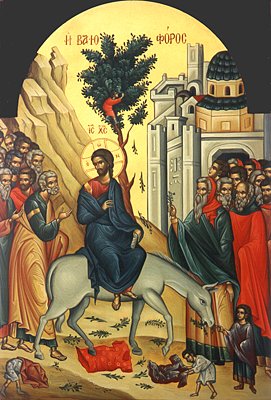
Palm Sunday, which is a week before Easter, commemorates the entrance of Jesus into the city of Jerusalem as children waved palm fronds. Palm Sunday marks the start of Holy Week.


This painting was created by George & Diana Voyajolu, Iconographers, Kamena Vourla, Greece. The Entry into Jerusalem. Byzantine style, contemporary artists.


Study Guide for Tuesday


  1. Read Matthew 21:1-17. This passage references the Old Testament three times. Copy down a quote in at least one of the verses (5, 13, or 16). Then read the Old Testament references, along with other adjacent verses in context: Isaiah 62:11-12, Isaiah 56:6-8, and Psalm 8:1-4.

  2. When Jesus entered the city of Jerusalem, the first place he went was the temple, where he “cleansed” it of all of the unholy things that were going on there. The temple is a symbol of our own hearts that Jesus wants to cleanse and transform into houses of prayer where he can dwell. Read Psalm 51:1-12 and think about it. Copy down the first verse.
  3. The hymn “All Glory, Laud and Honor” is about Jesus’ entry into Jerusalem. Read the words and listen to the music on-line at: All Glory, Laud and Honor. Read about the hymn and lyricist at Hymn Story and Theoldulph of Orleans. Write down when and where Theodulph lived and died.

  4. Click on each of these links to see a classic painting. For each one, tell me who the artist was, as well as about what year the painting was created. Entry Into Jerusalem and Christ's Entry Into Jerusalem. Then look at this stained glass: Triumphal Entry into Jerusalem on Palm Sunday and write at least one sentence about it. Be sure to read the descriptions!

  5. Choose one thing from today's assignments -- either a Scripture, the hymn, or a piece of artwork -- and write a response paragraph of at least five sentences that describe it and tell of your personal opinions about it.

Easter Week Assignment for Wednesday


Wednesday, April 7, 2009
Theme: The Last Supper and the Trial


  1. The painting "The Last Supper" (above) is by Leonardo da Vinci. He painted it in 1498 on the refectory (dining room) wall in the Convent of Santa Maria delle Grazie in Milan, Italy. It is 15 feet high and 29 feet long! Click on the picture to enlarge it. Then, pay attention to the details in the picture and write down a few sentences about what story it is telling.


  2. All four gospels (Matthew, Mark, Luke, and John) include the story of the "Last Supper" but each one differs in how they present what happened. Read Matthew 26:17-35, Mark 14:12-31, and John 13:1-37. Write down at least one detail in each passage that wasn't in the others. What parts of the story do all of them include? What is one thing that you can apply in your own life from these passages?


  3. Read about Gethsemane and the trial at Matthew 26:36-75. Copy down the four section headings from the Scripture passage.


  4. The painting "Ecce Homo" is by Swiss artist, Antonio Ciseri (October 25, 1821 – March 8, 1891). "Ecce Homo" means "Behold the Man." The scene is Jesus' trial before Pontius Pilate, who is listening to the crowd. Please click on it to enlarge it. Write a two sentence response to it.


Easter Week Assignments for Thursday

Thursday, April 9
Theme: The Death of Christ

Study Guide for Thursday


  1. Read Isaiah 53:1-12 and Psalm 22:1-18. These prophecies were written hundreds of years before Jesus was born, yet they foretell his death as the Messiah. Copy at least two verses from one of these passages. Write down at least two words from Isaiah 53 which are synonyms for the word sin.
  2. Click on When I Survey the Wondrous Cross. Read the lyrics, listen to the audio, and click on the verse reference. Copy down the Bible verse and the first stanza (four lines) of the hymn. Who is the lyricist (the man who wrote the words)? About how many centuries ago were the words written?

  3. Michelangelo sculpted the Pietà during the Renaissance era. ("Renaissance" is a French word which means rebirth.) Look at the sculpture carefully, and then write two sentences describing it. Then write another sentence telling who made it (including his last name), when it was created and where it is now. Then go to http://www.dictionary.com/ to find out what “pietà” means, and write the definition. What would it have been like to be Mary, holding Jesus' body after it was removed from the cross?
  4. Read Luke 23:26-56 and let it sink in. Imagine what it would have been like for you to be right there. Write several sentences as if you were making an entry in your journal the next day. You will continue this tomorrow in the assignment about the resurrection.

  5. Read the poem below and copy the first stanza.

"WHO OVERCAME EVIL BY GOOD"
by Mary Whitcomb Hess after a homily by Saint Amphilochius in the 4th Century

They stretch Him
On a Cross to die ---
Our Lord Who first
Stretched out the sky

Whose countenance
The cherubim
Dare not gaze on …
They spat on Him

And gave Him gall
To drink
Though He
Brings us wells
Of eternity.

He prays for them
“Father, forgive…”
For He was born
That all might live.

Round the sealed tomb
Of Him they’ve slain
They set a guard
In vain, in vain

Round Him
Creation can’t contain
Who dies for us
To rise again.


~*~*~


6. This tapestry below, "The Crucifixion" by Pieter Pannemaker, is found in the National Gallery of Art. You can click on it to enlarge it. How can you use your creative skills -- in visual arts, music, writing, or public speaking -- to communicate the message of Christ?


Easter Week Assignment for Friday


Friday, April 10, 2009

Theme: The Resurrection


"The Resurrection of Christ" was painted by Russian Orthodox artist Mikhail Nesterov at end of the 1890s.


Study Guide for Friday

  1. Read the story of the resurrection and the ascension in Matthew 28 and Luke 24. Copy at least one verse from each passage.

  2. Continue the journal entry you started yesterday, writing as if you were there when these things happened.

  3. Listen to Christ the Lord is Risen Today! by Charles Wesley. What word appears at the end of each line, and what is an alternate spelling for this word?

  4. Read a blog post by Julia Knowles on her 3 month mission trip to Bolivia: *Behold, I am making all things new* :) Revelation 21 At the bottom, she talks about heaven. What famous preacher did she quote and when did he preach his sermon, "No Tears in Heaven"? (Be sure to pray for Julia today, April 10, as she flies home!).

  5. Look at the painting, "Le Jour des Morts" (The Day of Death) by William Beaugereau in 1859. According to 1 Corinthians 15:35-58, what hope do we have because of the resurrection of Christ?


Tuesday, March 10, 2009

The Great Commandment and the Great Commission

(Note: Please pardon the odd and inconsistent font. Blogger seems to be having a problem this morning.)


Yesterday, in the 7th-8th grade English class, I assigned a persuasive essay on why Christians need to obey both the Great Commandment (love your neighbor) and the Great Commission (preach the gospel). We talked about how some people succumb to the either-or fallacy of focusing on one to the exclusion of the other. Julie Brackin and I also role-played a conversation between a Christian and an agnostic using the "Are You Good Enough?" booklet that Metro Life Church has been providing for outreach. I have compiled a list of Scriptures about the subject to help them as they research their essays. I trust that they will helpful to all of us. After each passage, there is a link to that entire chapter on www.ESV.org so you can read them in the larger context.


The Great Commandment and the Great Commission


The Great Commandment:


Matthew 22:34 “But when the Pharisees heard that he had silenced the Sadducees, they gathered together. 35 And one of them, a lawyer, asked him a question to test him. 36 “Teacher, which is the great commandment in the Law?” 37 And he said to him, “You shall love the Lord your God with all your heart and with all your soul and with all your mind. 38 This is the great and first commandment. 39 And a second is like it: You shall love your neighbor as yourself. 40 On these two commandments depend all the Law and the Prophets.”” Matthew 22


The Great Commission:


Matthew 28:16 “Now the eleven disciples went to Galilee, to the mountain to which Jesus had directed them. 17 And when they saw him they worshiped him, but some doubted. 18 And Jesus came and said to them, “All authority in heaven and on earth has been given to me. 19 Go therefore and make disciples of all nations, baptizing them in the name of the Father and of the Son and of the Holy Spirit, 20 teaching them to observe all that I have commanded you. And behold, I am with you always, to the end of the age.” Matthew 28


~*~*~


The following Scriptures are about the Great Commandment (love one another), the Great Commission (preach the gospel), and the core essentials of the gospel message.


Matthew 5:14 “You are the light of the world. A city set on a hill cannot be hidden. 15 Nor do people light a lamp and put it under a basket, but on a stand, and it gives light to all in the house. 16 In the same way, let your light shine before others, so that they may see your good works and give glory to your Father who is in heaven.” Matthew 5


John 3:16 “For God so loved the world, that he gave his only Son, that whoever believes in him should not perish but have eternal life. 17 For God did not send his Son into the world to condemn the world, but in order that the world might be saved through him. 18 Whoever believes in him is not condemned, but whoever does not believe is condemned already, because he has not believed in the name of the only Son of God. 19 And this is the judgment: the light has come into the world, and people loved the darkness rather than the light because their works were evil. 20 For everyone who does wicked things hates the light and does not come to the light, lest his works should be exposed. 21 But whoever does what is true comes to the light, so that it may be clearly seen that his works have been carried out in God.” John 3


John 13:34 “A new commandment I give to you, that you love one another: just as I have loved you, you also are to love one another. 35 By this all people will know that you are my disciples, if you have love for one another.” John 13


John 14:6 “Jesus said to him, ‘I am the way, and the truth, and the life. No one comes to the Father except through me. 7 If you had known me, you would have known my Father also. From now on you do know him and have seen him.’” John 14


Acts 1:8 “But you will receive power when the Holy Spirit has come upon you, and you will be my witnesses in Jerusalem and in all Judea and Samaria, and to the end of the earth.” Acts 1


Acts 4:12 “And there is salvation in no one else, for there is no other name under heaven given among men by which we must be saved.” Acts 4


Romans 1:14 I am under obligation both to Greeks and to barbarians, both to the wise and to the foolish. 15 So I am eager to preach the gospel to you also who are in Rome. 16 For I am not ashamed of the gospel, for it is the power of God for salvation to everyone who believes, to the Jew first and also to the Greek. 17 For in it the righteousness of God is revealed from faith for faith, as it is written, “The righteous shall live by faith.” 18 For the wrath of God is revealed from heaven against all ungodliness and unrighteousness of men, who by their unrighteousness suppress the truth. 19 For what can be known about God is plain to them, because God has shown it to them. 20 For his invisible attributes, namely, his eternal power and divine nature, have been clearly perceived, ever since the creation of the world, in the things that have been made. So they are without excuse.” Romans 1


Romans 10:14 “How then will they call on him in whom they have not believed? And how are they to believe in him of whom they have never heard? And how are they to hear without someone preaching? 15 And how are they to preach unless they are sent? As it is written, “How beautiful are the feet of those who preach the good news!” 16 But they have not all obeyed the gospel. For Isaiah says, “Lord, who has believed what he has heard from us?” 17 So faith comes from hearing, and hearing through the word of Christ.” Romans 10


2 Corinthians 5:11 “Therefore, knowing the fear of the Lord, we persuade others. But what we are is known to God, and I hope it is known also to your conscience… 17 Therefore, if anyone is in Christ, he is a new creation. The old has passed away; behold, the new has come. 18 All this is from God, who through Christ reconciled us to himself and gave us the ministry of reconciliation; 19 that is, in Christ God was reconciling the world to himself, not counting their trespasses against them, and entrusting to us the message of reconciliation. 20 Therefore, we are ambassadors for Christ, God making his appeal through us. We implore you on behalf of Christ, be reconciled to God.” 2 Corinthians 5


Ephesians 2:8 “For by grace you have been saved through faith. And this is not your own doing; it is the gift of God, 9 not a result of works, so that no one may boast. 10 For we are his workmanship, created in Christ Jesus for good works, which God prepared beforehand, that we should walk in them.” Ephesians 2


Colossians 1:27 “To them God chose to make known how great among the Gentiles are the riches of the glory of this mystery, which is Christ in you, the hope of glory. 28 Him we proclaim, warning everyone and teaching everyone with all wisdom, that we may present everyone mature in Christ. 29 For this I toil, struggling with all his energy that he powerfully works within me.” Colossians 1


1 Timothy 6:18-19 “They are to do good, to be rich in good works, to be generous and ready to share, 19 thus storing up treasure for themselves as a good foundation for the future, so that they may take hold of that which is truly life.” 1 Timothy 6


James 2:14 “What good is it, my brothers, if someone says he has faith but does not have works? Can that faith save him? 15 If a brother or sister is poorly clothed and lacking in daily food, 16 and one of you says to them, “Go in peace, be warmed and filled,” without giving them the things needed for the body, what good is that? 17 So also faith by itself, if it does not have works, is dead.” James 2


1 Peter 2:12 “Keep your conduct among the Gentiles honorable, so that when they speak against you as evildoers, they may see your good deeds and glorify God on the day of visitation.” 1 Peter 2


1 John 3:16 “By this we know love, that he laid down his life for us, and we ought to lay down our lives for the brothers. 17 But if anyone has the world's goods and sees his brother in need, yet closes his heart against him, how does God's love abide in him? 18 Little children, let us not love in word or talk but in deed and in truth.” 1 John 3

Tuesday, December 9, 2008

December 7th and 8th Grade English Classes

Dear friends,

In the 7th-8th grade English class, we are doing a two week series of on-line lessons on Advent using Scripture, fine art, music, poetry, and film. I have already posted the homework assignments for 8 days, which you can find by clicking here: Advent Assignments. This week's assignments are at the top.

As a recap of what we did during the two Monday classes in December:

December 1:
  • Read and discussed Luke 1
  • Read student Thanksgiving stories and poems
  • Looked at pictures from the book One Wintry Night by Ruth Bell Graham and discussed the concept that the Biblical story of redemption does not begin with the birth of Christ but with creation
  • Read an abridged version of classic O. Henry short story The Gift of the Magi
  • Listened to Christmas music by Sara Groves.

December 8:

  • Read and discussed Luke 6,
  • Read student responses to last week's art and literature assignments
  • Looked at all of the Giotto paintings on the life of Christ and read two poetic essays from Madeline L'Engle's book The Glorious Impossible
  • Read my new poem "The Story Did Not Start with a Stable and a Star" (which is also included in the December 10 assignment)
  • Compared three different versions (Celine Dion, National Christian Choir, and Sara Groves) of the song "O Holy Night"
We probably did a few other things each of these weeks, and we certainly took some bunny trails off of the aforementioned topics, but those are the main things.

Anyone is welcome to use the lessons I have posted. You can always adapt them for younger or older students.

Blessings,
Virginia Knowles

Sunday, December 7, 2008

Jesus, Friend of Sinners

This post is the 7th-8th grade English assignment for Tuesday, December 9.

  1. Read Luke 7. Which verses are related to the painting below? How does this story relate to why Jesus had to come to earth in the first place?


"The Magdalen" by Bernardino Luini in 1525


(National Gallery of Art)


2. Read this poem, which is based on the Bible story in Luke 7:36-50. According to this poem, how is the symbolism of the broken alabaster jar related to how we should live for Jesus?

"Alabaster Jar"
by Virginia Knowles

Alabaster jar, costly sweet perfume
Devotion broke it open, fragrance filled the room.
Poured over Jesus’ head, anointing for the grave,
Some saw only money lost, but Jesus blessed the love she gave.
Broken and poured out, broken and poured out
But there’s no waste of life, just fragrant sacrifice
And it’s all because of love.

Can you see his love? Messiah on the cross
Body broken, blood poured out, for our sin’s redemption cost
Can you see his power? Victory over death!
Hell could not contain him, nor quench his living breath
Broken and poured out, broken and poured out
But there’s no waste of life, just fragrant sacrifice
And it’s all because of love.

Lord, break me for your glory, pour me for your name.
Let me share his sufferings and power just the same.
Crucified with Christ is what I want to be,
For when I’ve died to my old life, I’ll rise up to be free.
Broken and poured out, broken and poured out
But there’s no waste of life, just fragrant sacrifice
And it’s all because of love.

3. Read Luke 5:27-32 and Luke 18:9-14. Write a paragraph explaing how Jesus wants us to view ourselves, and how he wants us treat those who have lived sinful lifestyles.

4. With your parent's permission, visit the Magdalena, Released from Shame web site and click on "Discover Their Story" to scroll over each of the four women and see short videos about them. This movie is produced by The Jesus Film Project, a division of Campus Crusade.


Baby Jesus at the National Gallery of Art

This post contains the 7th-8th grade English assignment for Wednesday, December 10.

Instructions:
  1. Read Luke 8 and write down the section heading for verses 46-49.

  2. Look at each of the nine pictures very carefully. You can click on them to enlarge them. The dates listed are approximately when the art was created. The paintings are from the National Gallery of Art in Washington, D.C., which I visited in November. All of the ones in this post are related to the birth of Christ. I had to take the pictures from a slight angle because otherwise I was getting a glare from the flash.

  3. These paintings and sculptures were created during the Renaissance. Some of them are gilded. Many of the the titles contain the words madonna and adoration. Click on each of these four bolded words and write down definitions.

  4. Which three pieces are not flat paintings?

  5. Which pieces were created in the 14th century? (Think carefully about this.)

  6. Three of the paintings have an instruction marked with **. Choose one to do.

  7. Read the poem "The Story Did Not Start with a Stable and a Star" which is below the pictures.

"The Adoration of the Shepherds" by Giorgione, 1505-1510


"Adoration of the Shepherds" after Annibale Fontana, 1600s, Terracotta

The words "after Annibale Fontana" means that he didn't create it himself, but it was based on one of his pieces.

In Italian, "terra" means "earth" and "cotta" means "cooked" or "baked." The American Heritage dictionary says that "terracotta" is "A hard semifired waterproof ceramic clay used in pottery and building construction." Firing is hardening or baking in an oven. There is one other terracotta piece in this blog post.


"The Adoration of the Magi" by Benvenuto di Giovanni in 1470-1475


"Madonna and Child" by the Florentine School 1425

Click here to see another Madonna and Child sculpture at the NGA.


** Copy down the Latin inscription at its base.


"Madonna and Child" by Circle of Giovanni di Turino 1430, painted and gilded terracotta


"Madonna Enthroned with Saints and Angels" by Agnolo Gaddi 1380-1390


** How is this painting and its frame similar to the Giotto one below? How is it different? (Think about the subject, style, media and shapes.)


"Madonna and Child" by Giotto 1320-1330


"The Alba Madonna" by Raphael in 1510 (St. John the Baptist is the other child in this painting.)

Read about this painting at: Alba Madonna.
** Write a sentence about the significance of what the baby Jesus is holding in his hand.


"The Flight into Egypt" by Vittore Carpaccio, 1515


~*~*~

"The Story Did Not Start with a Stable and a Star"

by Virginia Knowles

The story did not start with a stable and a star
But in the beginning, before billygoats on boulders or bluebirds in birch trees
The Trinity, the Three-In-One: Father, Spirit, Son
Viewed a vast void with a venturesome vision
And lo, this Lavish LORD said, “Let there be…”
And there was Light and Life and Love
Tigers and tiger lilies and tiger sharks
Amoebas and ants, aardvarks and apple trees,
Honeysuckle and honeybees and heavenly hallelujahs
For it was good: this grand garden, green and growing, glorious and glowing
With two to tend Eden: Adam and Eve
Masterpieces made to multiply more masterpieces in the image of their Maker
Working and walking with Him, worshiping Him for the wonder of His wisdom
But then came a choice and a cheater and a chilling challenge
They rebelled and rejected and ruined their Royal Relationship
In punishment, pushed out from Paradise into pain and peril, perishing
Generation after generation
Mankind multiplied moral messes
The Spirit sometimes seized sinners into the Sovereign Sacred Story
Prodding prophets, priests, and preachers to proclaim:
“Repent! Return! Revere! Renew!”
And so the Father sent his Son
And seers sought this Savior from afar
But the story did not stop with a stable and a star

The little Lord Jesus, who lay there so lowly, lived his life
This Great God-With-Us grew in grace
He, the Holy One, who helped and healed
Preached and prayed and praised His Father
This Lord of Love looked high and low to liberate the lost
This consecrated Christ carried His cross
He was crucified in His courage by our cowardice
Thus our Prophet-Priest paid the penalty price for our Paradise
His ransom rescues rebels from ruin
Freeing those who by faith will fully follow
Generation after generation
Multiplying more miracles among mortals
For the Spirit of the Sovereign Sacred Story
Still seizes sinners and sanctifies saints
And our Royal Redeemer shall return:
Holy is He! Hark the heavenly hallelujahs!
For it is good and God is glorious!
Earth shall end and eternity shall start
And the story of the Savior shall always speak to the heart.

“In the beginning, God created the heavens and the earth…” Genesis 1:1

"In the beginning was the Word, and the Word was with God, and the Word was God. He was with God in the beginning. Through him all things were made; without him nothing was made that has been made. In him was life, and that life was the light of men. The light shines in the darkness, but the darkness has not understood it… He was in the world, and though the world was made through him, the world did not recognize him. He came to that which was his own, but his own did not receive him. Yet to all who received him, to those who believed in his name, he gave the right to become children of God— children born not of natural descent, nor of human decision or a husband's will, but born of God. The Word became flesh and made his dwelling among us. We have seen his glory, the glory of the One and Only, who came from the Father, full of grace and truth.” John 1:1-5, 10-14

The Lord Has Come

This post is the 7th-8th grade English assignment for Thursday, December 11.

  1. Read Luke 9. Copy verses 23-25.

  2. What does the word "advent" mean? What is the Latin root?

  3. Click to see the lyrics to Joy to the World. Then go to the bottom of the page and listen to all five days of radio devotionals for this song. Next, read the Devotional and Hymn Story and be sure to click on the "See More" links when they are given. Who wrote the words to this carol? Who wrote the music?

  4. Click to see the lyrics to O Come, O Come, Emmanuel. Click on the links to listen to it. Read all of the notes, pressing the "See More" links when they are given. What are the two Scripture references listed? Write down the meaning of the name "Emmanuel." Then watch a GodTube montage video of a modern version of it at: O Come, O Come Emmanuel. (It starts really slow, but picks up after about a minute.)

  5. Which of these two songs was written in a minor key? Which was written in a major key? What is the difference in the mood of the tune? How is repetition used in each of the songs?

  6. What is your favorite Christmas carol? Why? (Write at least four sentences.)

The Jesus Film Project

This post is the 7th-8th grade English assignment for Friday, December 12.


Instructions:


  1. Read Luke 10.

  2. Watch at least an hour of the Jesus Film. (Scroll down the page until you see "English" and then click on WATCH.) See how many of the scenes you remember from the first 10 chapters of Luke. If you have a DVD or video of the movie, watch it on your TV instead! Have your parent write a note verifying that you watched it.

  3. The Jesus Film has been translated into over a thousand languages and is shown all over the world as an evangelistic outreach. It is often played for large crowds outdoors, as shown below with the Maasai in Africa. Read the page Making Film Translations and list the five steps. (Make sure you click on them to read about them.)

4. Imagine that you are part of the team that is producing and presenting The Jesus Film for people around the world. Think about how God has uniquely gifted you, and tell which two of these jobs you feel you would be interested in doing: writing the script, translating it into other languages, acting, directing, makeup & costuming, set design, sound effects, producing the soundtrack, going out to the villages and showing the film, or another related job that you can think of.

Friday, November 28, 2008

The Life of Christ fresco paintings by Giotto

This post, which everyone is invited to enjoy, contains the Tuesday, December 2, English class assignment for the 7th-8th graders.

1. Read about Giotto.

2. Look at the following paintings. You can click on them to enlarge them. Note: We are reading through several chapters of Luke in the next couple of weeks. Today's chapter, Luke 2, accompanies the paintings.

3. Pick one of paintings to write about. In one paragraph, describe it in detail and in another, share your own response to it (what it means to you, what you like about it, etc.). Finally, copy at least a few key sentences of the Scripture that goes with your chosen painting.

These seven paintings by Giotto (1267-1337) are just part of the series of frescoes found in the Scrovegni Chapel in Padua, Italy. I found them on-line at http://www.wga.hu/. The painting titles are in bold print above each picture, and the Scriptures are from the New International Version.

The Visitation

At that time Mary got ready and hurried to a town in the hill country of Judea, where she entered Zechariah's home and greeted Elizabeth. When Elizabeth heard Mary's greeting, the baby leaped in her womb, and Elizabeth was filled with the Holy Spirit. In a loud voice she exclaimed: "Blessed are you among women, and blessed is the child you will bear! But why am I so favored, that the mother of my Lord should come to me? As soon as the sound of your greeting reached my ears, the baby in my womb leaped for joy. Blessed is she who has believed that what the Lord has said to her will be accomplished!" And Mary said: "My soul glorifies the Lord and my spirit rejoices in God my Savior, for he has been mindful of the humble state of his servant. From now on all generations will call me blessed, for the Mighty One has done great things for me— holy is his name. His mercy extends to those who fear him, from generation to generation. He has performed mighty deeds with his arm; he has scattered those who are proud in their inmost thoughts. He has brought down rulers from their thrones but has lifted up the humble. He has filled the hungry with good things but has sent the rich away empty. He has helped his servant Israel, remembering to be merciful to Abraham and his descendants forever, even as he said to our fathers." Mary stayed with Elizabeth for about three months and then returned home. -- Luke 1:39-56


The Birth of Jesus

In those days Caesar Augustus issued a decree that a census should be taken of the entire Roman world. (This was the first census that took place while Quirinius was governor of Syria. And everyone went to his own town to register. So Joseph also went up from the town of Nazareth in Galilee to Judea, to Bethlehem the town of David, because he belonged to the house and line of David. He went there to register with Mary, who was pledged to be married to him and was expecting a child. While they were there, the time came for the baby to be born, and she gave birth to her firstborn, a son. She wrapped him in cloths and placed him in a manger, because there was no room for them in the inn. And there were shepherds living out in the fields nearby, keeping watch over their flocks at night. An angel of the Lord appeared to them, and the glory of the Lord shone around them, and they were terrified. But the angel said to them, "Do not be afraid. I bring you good news of great joy that will be for all the people. Today in the town of David a Savior has been born to you; he is Christ the Lord. This will be a sign to you: You will find a baby wrapped in cloths and lying in a manger." Suddenly a great company of the heavenly host appeared with the angel, praising God and saying, "Glory to God in the highest, and on earth peace to men on whom his favor rests." When the angels had left them and gone into heaven, the shepherds said to one another, "Let's go to Bethlehem and see this thing that has happened, which the Lord has told us about." So they hurried off and found Mary and Joseph, and the baby, who was lying in the manger. When they had seen him, they spread the word concerning what had been told them about this child, and all who heard it were amazed at what the shepherds said to them. But Mary treasured up all these things and pondered them in her heart. The shepherds returned, glorifying and praising God for all the things they had heard and seen, which were just as they had been told." Luke 2:1-20


Presentation at the Temple
"On the eighth day, when it was time to circumcise him, he was named Jesus, the name the angel had given him before he had been conceived. When the time of their purification according to the Law of Moses had been completed, Joseph and Mary took him to Jerusalem to present him to the Lord (as it is written in the Law of the Lord, "Every firstborn male is to be consecrated to the Lord", and to offer a sacrifice in keeping with what is said in the Law of the Lord: "a pair of doves or two young pigeons." Now there was a man in Jerusalem called Simeon, who was righteous and devout. He was waiting for the consolation of Israel, and the Holy Spirit was upon him. It had been revealed to him by the Holy Spirit that he would not die before he had seen the Lord's Christ. Moved by the Spirit, he went into the temple courts. When the parents brought in the child Jesus to do for him what the custom of the Law required, Simeon took him in his arms and praised God, saying: "Sovereign Lord, as you have promised, you now dismiss your servant in peace. For my eyes have seen your salvation, which you have prepared in the sight of all people, a light for revelation to the Gentiles and for glory to your people Israel." The child's father and mother marveled at what was said about him. Then Simeon blessed them and said to Mary, his mother: "This child is destined to cause the falling and rising of many in Israel, and to be a sign that will be spoken against, so that the thoughts of many hearts will be revealed. And a sword will pierce your own soul too." There was also a prophetess, Anna, the daughter of Phanuel, of the tribe of Asher. She was very old; she had lived with her husband seven years after her marriage, and then was a widow until she was eighty-four. She never left the temple but worshiped night and day, fasting and praying. Coming up to them at that very moment, she gave thanks to God and spoke about the child to all who were looking forward to the redemption of Jerusalem." Luke 2:-21-38

Adoration of the Magi

(Please note that even though this painting shows the visit of the magi to the birth scene, it actually occurred later, perhaps even when Jesus was a toddler. At any rate, we at least know that it was after the presentation at the temple, because just after this event, the young family fled to Egypt.)

After Jesus was born in Bethlehem in Judea, during the time of King Herod, Magi from the east came to Jerusalem and asked, "Where is the one who has been born king of the Jews? We saw his star in the east and have come to worship him." When King Herod heard this he was disturbed, and all Jerusalem with him. When he had called together all the people's chief priests and teachers of the law, he asked them where the Christ was to be born. "In Bethlehem in Judea," they replied, "for this is what the prophet has written: " 'But you, Bethlehem, in the land of Judah, are by no means least among the rulers of Judah; for out of you will come a ruler who will be the shepherd of my people Israel." Then Herod called the Magi secretly and found out from them the exact time the star had appeared. He sent them to Bethlehem and said, "Go and make a careful search for the child. As soon as you find him, report to me, so that I too may go and worship him." After they had heard the king, they went on their way, and the star they had seen in the east went ahead of them until it stopped over the place where the child was. When they saw the star, they were overjoyed. 11On coming to the house, they saw the child with his mother Mary, and they bowed down and worshiped him. Then they opened their treasures and presented him with gifts of gold and of incense and of myrrh. And having been warned in a dream not to go back to Herod, they returned to their country by another route." Matthew 2:1-12

The Flight into Egypt

When they had gone, an angel of the Lord appeared to Joseph in a dream. "Get up," he said, "take the child and his mother and escape to Egypt. Stay there until I tell you, for Herod is going to search for the child to kill him." So he got up, took the child and his mother during the night and left for Egypt, where he stayed until the death of Herod. And so was fulfilled what the Lord had said through the prophet: "Out of Egypt I called my son." Matthew 2:13-15


The Massacre of the Innocents

When Herod realized that he had been outwitted by the Magi, he was furious, and he gave orders to kill all the boys in Bethlehem and its vicinity who were two years old and under, in accordance with the time he had learned from the Magi. Then what was said through the prophet Jeremiah was fulfilled: "A voice is heard in Ramah, weeping and great mourning, Rachel weeping for her children and refusing to be comforted, because they are no more." After Herod died, an angel of the Lord appeared in a dream to Joseph in Egypt and said, "Get up, take the child and his mother and go to the land of Israel, for those who were trying to take the child's life are dead." So he got up, took the child and his mother and went to the land of Israel. But when he heard that Archelaus was reigning in Judea in place of his father Herod, he was afraid to go there. Having been warned in a dream, he withdrew to the district of Galilee, and he went and lived in a town called Nazareth. So was fulfilled what was said through the prophets: "He will be called a Nazarene." Matthew 2:16-23


Christ Among the Doctors

Every year his parents went to Jerusalem for the Feast of the Passover. When he was twelve years old, they went up to the Feast, according to the custom. After the Feast was over, while his parents were returning home, the boy Jesus stayed behind in Jerusalem, but they were unaware of it. Thinking he was in their company, they traveled on for a day. Then they began looking for him among their relatives and friends. When they did not find him, they went back to Jerusalem to look for him. After three days they found him in the temple courts, sitting among the teachers, listening to them and asking them questions. Everyone who heard him was amazed at his understanding and his answers. When his parents saw him, they were astonished. His mother said to him, "Son, why have you treated us like this? Your father and I have been anxiously searching for you." "Why were you searching for me?" he asked. "Didn't you know I had to be in my Father's house?"But they did not understand what he was saying to them. Then he went down to Nazareth with them and was obedient to them. But his mother treasured all these things in her heart. And Jesus grew in wisdom and stature, and in favor with God and men." Luke 2:41-52

Silent Night

This is the Wednesday, December 3, assignment for the 7th-8th grade English class.

1. Read Luke 3.

2. Read the lyrics to "Silent Night" by Josef Mohr.


Silent Night
by Josef Mohr

Silent night, holy night,
All is calm, all is bright
Round yon virgin mother and Child.
Holy Infant, so tender and mild,
Sleep in heavenly peace,
Sleep in heavenly peace.

Silent night, holy night,
Shepherds quake at the sight;
Glories stream from heaven afar,
Heavenly hosts sing Alleluia!
Christ the Savior is born,
Christ the Savior is born!

Silent night, holy night,
Son of God, love’s pure light;
Radiant beams from Thy holy face
With the dawn of redeeming grace,
Jesus, Lord, at Thy birth,
Jesus, Lord, at Thy birth.

Silent night, holy night
Wondrous star, lend thy light;
With the angels let us sing,
Alleluia to our King;
Christ the Savior is born,
Christ the Savior is born!

~*~*~

3. Watch this YouTube video of the song Silent Night, accompanied by scenes from the Jesus movie. If you can't watch it, find a version on CD and listen to it.

4. Copy one verse of the hymn in your best handwriting and draw at least one picture to go with it.

5. Read "The Story of Silent Night, Stille Nacht" by Dr. Ralph F. Wilson. Please note that not all historians agree on the account of how it happened.

6. Watch the German version, Stille Nacht. From a Wikipedia article: It is believed that the carol has been translated into over 300 languages and dialects around the world, and it is one of the most popular carols of all time. It is sometimes sung without musical accompaniment. Although written by Catholics, it is given special significance in Lutheranism. The song was sung simultaneously in English and German by troops during the Christmas truce of 1914, as it was one of the few carols that soldiers on both sides of the front line knew.

More Christmas Poems

This is the Thursday, December 4, assignment for the 7th-8th grade English class.

1. Read Luke 4 and copy the three verses where Jesus replies to the devil during his temptation.

2. Read all three poems below.

3. Write a one paragraph response to one of them. What does it mean to you? What do you like best about it? Be sure to quote at least two lines in your response.

Jesous Ahatonhia
by Father Jean de Brébeuf, Jesuit missonary to Canada, in 1642
interpretation by J. E. Middleton

'Twas in the moon of wintertime
When all the birds had fled,
That Mighty Gitchi Manitou
Sent angel-choirs instead;
Before their light the stars grew dim,
And wondering hunters heard the hymn—
Jesus your King is born, Jesus is born,
In excelsis gloria.

Within a lodge of broken bark
The tender Babe was found,
A ragged robe of rabbit skin
Enwrapped His beauty round;
But as the hunter braves drew nigh,
The angel song rang loud and high--
Jesus your King is born, Jesus is born,
In excelsis gloria.

The earliest moon of wintertime
Is not so round and fair
As was the ring of glory on
The helpless Infant there.
The Chiefs from far before Him knelt
With gifts of fox and beaver pelt--
Jesus your King is born, Jesus is born,
In excelsis gloria.

O children of the forest free,
O sons of Manitou,
The Holy Child of earth and Heaven
Is born today for you.
Come kneel before the radiant Boy,
Who brings you beauty, peace, and joy--
Jesus your King is born, Jesus is born,
In excelsis gloria.


~*~*~


Star-Silver
by Carl Sandburg

The silver of one star
plays cross-lights against pine-green
And the play of this silver cross-wise against the green is an old story.
Thousands of years.
And sheep grazers on the hills by night
watching the woolly four-footed ramblers
watching a single silver star.
Why does this story never wear out?
And a baby, slung in a feed box back in a barn in a Bethlehem slum
A baby's first cry,
mixing with the crunch of a mule's teeth on Bethlehem Christmas corn
Baby fists, softer than snowflakes of Norway
The vagabond mother of Christ
and the vagabond men of wisdom
all in a barn on a winter night
and a baby there in swaddling clothes on hay
Why does this story never wear out?
The sheen of it all--is a star, silver and a pine, green
For the heart of a child asking a story
The red and hungry, red and hankering heart
Calling for cross-lights of silver and green


~*~*~*~


The Paradox


by Virginia Knowles


Come, see where He lays,
Good Shepherd and Little Lamb
King of Kings and Servant of All
Prophet and Prophecy Fulfilled
Physician and Wounded One
High Priest and Atoning Sacrifice
Counselor and Rejected One
Builder and Foundation Stone
Righteous Judge and Condemned Prisoner
Ancient of Days and Newly-born Babe
God and Man

Here are the Bible verses for each line of the poem.

  • Lying in a manger: Luke 2:12
  • Shepherd: John 10: 11 / Lamb: John 1:29
  • King: Revelation 19:16 / Servant: Mark 10:43-45, Philippians 2:7
  • Prophet: Luke 7:16 / Prophecy: Matthew 1:22, Luke 4:16-21, Isaiah 61:1-3
  • Physician: Matthew 15:30 / Wounded: Isaiah 53:4-6
  • Priest: Hebrews 7:23-28 / Sacrifice: Hebrews 9:11-14, 10:19-22
  • Counselor: Isaiah 9:6 / Rejected: Isaiah 53:3, John 10:22-33
  • Builder: Hebrews 3:3, Matthew 16:18 / Foundation: 1 Peter 2:4-9
  • Judge: John 8:1-11, Acts 10:42-43 & 17:30-31 / Prisoner: Mark 14:60-65
  • Ancient: Daniel 7:13-14 / Newborn: Luke 2:8-20
  • God: John 1:1-5, Hebrews 1:3, Colossians 1:19-20 / Man: 1 Timothy 2:5, Romans 1:1-4

Saint Nicholas

This is the Friday, December 5, assignment for the 7th-8th grade English class.

1. Read Luke 5 and copy verses 31-32.

2. Look at a painting of St. Nicholas. Read the story, The Real St. Nick. Then write one paragraph about who the real St. Nicholas was.

3. Read "Twas the Night Before Christmas" poem by Clement Moore, and the Mex-American version of the same poem below. Then do the questions and activities following them.


"A Vision of St. Nicholas"

'Twas the night before Christmas, when all through the house
Not a creature was stirring, not even a mouse;
The stockings were hung by the chimney with care,
In hopes that St. Nicholas soon would be there.


The children were nestled all snug in their beds,
While visions of sugarplums danced in their heads;
And Mamma in her kerchief, and I in my cap,
Had just settled our brains for a long winter's nap--

When out on the lawn there arose such a clatter,
I sprang from my bed to see what was the matter.
Away to the window I flew like a flash,
Tore open the shutters, and threw up the sash.

The moon, on the breast of the new-fallen snow,
Gave the luster of mid-day to objects below,
When, what to my wondering eyes should appear,
But a miniature sleigh, and eight tiny reindeer,

With a little, old driver, so lively and quick,
I knew in a moment it must be St. Nick.
More rapid than eagles, his coursers they came,
And he whistled, and shouted, and called them by name;

"Now, Dasher! now, Dancer! Now, Prancer and Vixen!
On, Comet! on, Cupid! on, Donder and Blitzen!
To the top of the porch, to the top of the wall!
Now dash away! dash away! dash away all!"


As dry leaves that before the wild hurricane fly,
When they meet with an obstacle, mount to the sky,
So, up to the housetop, the reindeer they flew,
With a sleigh full of toys--and St. Nicholas too.

And then in a twinkling, I heard on the roof,
The prancing of reindeer and pawing of each little hoof.
As I drew in my head, and was turning around,
Down the chimney St. Nicholas came with a bound.


He was dressed all in fur, from his head to his foot,
And his clothes were all tarnished with ashes and soot.
A bundle of toys he had flung on his back,
And he looked like a peddler just opening his pack.


His eyes, how they twinkled! His dimples, how merry!
His cheeks were like roses, his nose like a cherry!
His droll little mouth was drawn up like a bow,
And the beard on his chin was as white as the snow.


The stump of a pipe he held tight in his teeth,
And the smoke, it encircled his head like a wreath.
He had a broad face and a little round belly,
That shook when he laughed, like a bowl full of jelly.


He was chubby and plump--a right jolly old elf,
And I laughed when I saw him, in spite of myself.
A wink of his eye, and a twist of his head,
Soon gave me to know I had nothing to dread.


He spoke not a word, but went straight to his work,
And filled all the stockings; then turned with a jerk,
And laying his finger aside of his nose,
And giving a nod, up the chimney he rose.


He sprang to his sleigh, to his team gave a whistle,
And away they all flew like the down of a thistle.
But I heard him exclaim ere they drove out of sight,
"Happy Christmas to all, and to all a good night!"

~*~*~


‘Twas the Night Before Christmas

(Mex-American Version)

‘Twas the night before Christmas y por toda la casa,
Not a creature was stirring-Caramba! Que pasa?
Los niños were tucked away in their camas,
Some in long underwear, some in pijamas,
While hanging the medias with mucho ciudado
In hopes that old Santa would feel obligado
To bring all children, both buenos y malos,
A nice batch of dulces y otros regalos.
Outside in the yard there arose such a grito
That I jumped to my pies like a frightened cabrito.
I ran to the window and looked out afuera,
And who in the world do you think that it era?
Saint Nick in a sleigh and a big red sombrero
Came dashing along like a crazy bombero.
And pulling his sleigh instead of venados
Were eight little burros approaching volados.
I watched as they came and this quaint little hombre
Was shouting and whistling and calling by nombre:
"Ay Pancho, ay Pepe, ay Cuco, ay Berto,
Ay Chato, ay Chopo, Macuco, y Nieto!"
Then standing erect with his hands on his pecho
He flew to the top of our very own techo.
With his round little belly like a bowl of jalea,
He struggled to squeeze down our old chiminea,
Then huffing and puffing at last in our sala,
With soot smeared all over his real suit de gala,
He filled all the medias with lovely regalos-
For none of the niños had been very malos.
Then chuckling aloud, seeming muy contento,
He turned like a flash and was gone como viento.
And I heard him exclaim, and this is verdad,
Merry Christmas to all, y Feliz Navidad!


Questions and Activities for “Twas the Night Before Christmas”
  1. Read these poems aloud! When you are pronouncing the Spanish words in the first poem, remember that usually the emphasis is on the second to the last syllable.

  2. What does "Feliz Navidad" mean?

  3. Which poem has more description of Santa Claus?

  4. Clement Moore was a seminary professor who wrote this poem as a Christmas gift for his six children in 1822. Also known as “Twas the Night Before Christmas” it has formed the basis of our modern American view of Santa Claus. The Santa Claus legend, which is known around the world in different forms, is based on a real man named Saint Nicholas. You can read about him at: Saint Nicholas Center.